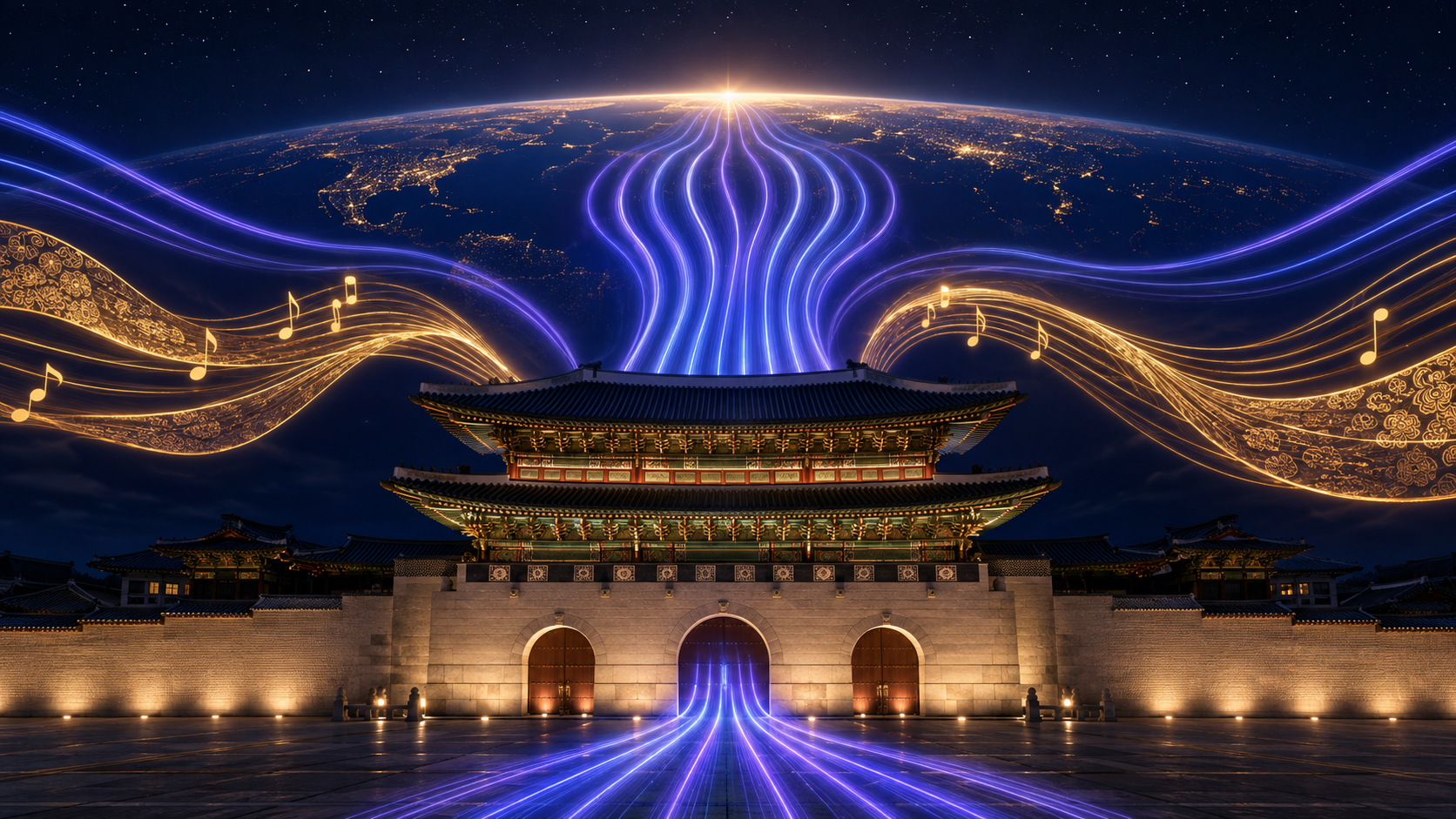
The Boundaries and Interests Hidden Behind the Label “Asian Pop”
BTS’s refusal forced the world to ask
whether “Asian Pop” represented a new form of recognition—
or a new boundary confining Asian music to a regional category.
On July 29, 2026, all seven members of BTS posted the same statement on their individual social media accounts.
“We have decided not to submit to the Grammys this year.
We hope music can be heard and loved for what it is,
rather than being divided by region or language.” [2]
The statement was brief. BTS did not attack the Grammys or demand that other artists make the same choice. They simply stated the principle they considered important and acted according to it.
The global response, however, was anything but brief.
Across Asia, many saw a new boundary being drawn around music that had already reached a global audience. European commentators questioned why the musical diversity of an entire continent had been reduced to a single category. Latin audiences recognized a familiar history of being grouped under broad regional labels. In North America, the question began to shift from whether BTS could win a Grammy to whether the Grammys had the standards needed to judge BTS’s music fairly.
The controversy soon moved beyond the name of a single award.
To understand why, we need more than the facts of what happened. We must interpret what the decision meant, consider how it was experienced from different cultural positions, examine whether the classification was fair, and ask what kind of change it might produce.
To examine this controversy, I use a six-dimensional framework of judgment that I have developed: Interpretive Thinking, Developmental Perspective, Contextual Empathy, Ethical Reasoning, Directional Decision-Making, and Narrative Responsibility.
These dimensions are not labels imposed on the debate, but practical lenses for asking what happened, whose perspectives matter, what fairness requires, where the global music system should go next, and how this moment should be remembered.
Why Did the World React So Strongly to a Single Statement?
The world interpreted BTS’s decision not simply as giving up an award opportunity, but as a challenge to the way music is classified by region and language.
BTS did not explicitly name the new Grammy category in their statement.
Yet the timing of their announcement, combined with their reference to music being divided by region or language, led journalists and audiences around the world to connect their decision to the newly introduced ‘Best Asian Pop Music Performance’ category.
The Recording Academy announced the category in June 2026. It was designed to recognize music originating from or widely recognized within Asian markets, including but not limited to K-pop, J-pop, and C-pop. Eligible works were also required to make meaningful use of one or more Asian languages.
According to the Academy, the purpose was to celebrate the depth, diversity, and extraordinary growth of pop music from Asia while giving more artists opportunities for recognition. [1]
Recording Academy CEO Harvey Mason Jr. also clarified that submission to the Asian Pop category would not prevent an artist from being considered for General Field categories such as Album of the Year, Record of the Year, and Song of the Year. [2]
From this perspective, the new award appeared to be an effort toward inclusion rather than exclusion.
But the same institution can look very different depending on where an artist stands.
For artists who have not yet gained international visibility, a dedicated category may offer a valuable pathway to a global stage. For artists who have already crossed that threshold and competed alongside performers from around the world, it may feel like a boundary directing them back into a regional space.
The controversy, therefore, was not simply about whether a new award was good or bad.
Does separate recognition create more opportunities,
or does it keep the possibility of equal competition
within a separate space?
BTS’s decision made that question impossible to ignore.
Why Did Asia See a Boundary Before Recognition?
The concern in Asia was not caused by opposition to a new award, but by the possibility that music already reaching the world could once again be placed inside a regional boundary.
K-pop, J-pop, and C-pop are not a single musical genre.
J-pop encompasses idol music, rock, singer-songwriters, electronic music, anime music, and many other forms. C-pop covers music from mainland China, Hong Kong, Taiwan, and several linguistic and cultural regions. K-pop is also less a single musical style than a broad term describing diverse popular music and production systems developed in South Korea.
Yet the new Grammy category did not classify works solely by their musical characteristics. It also referred to their relationship with Asian markets and required meaningful use of an Asian language.
The Grammys may argue that artists are judged by musical style and achievement rather than by race or nationality. But when market origin and language are used to define “Asian” music, a regional boundary remains even if race and nationality are not directly named.
This does not mean that every Asian artist opposes the category.
For many musicians, producers, and labels, it may provide a rare and valuable path to Grammy recognition. BTS’s decision should not become a rule that other Asian artists are expected to follow. Each artist occupies a different position and has the right to make a different choice.
That difference in position is precisely what must be understood.
For an artist still outside the door,
the category may be an entrance to the global stage.
For an artist already competing on that stage,
it may look like a boundary asking them to step back.
Understanding Asia’s response requires more than examining the category’s official name. It requires Contextual Empathy—an effort to understand how the same institution is experienced differently by artists standing in different places.
Why Did European and Latin Audiences Recognize Their Own Experience?
European and Latin audiences connected the controversy to a longer history in which non-English music has been managed under separate and overly broad labels.
The question raised in Europe was relatively simple:
If the category was intended to recognize the diversity of Asian music, why was that diversity reduced once again to a single name—“Asian”?
Imagine a Grammy category called “European Pop” in which music from the United Kingdom, France, Germany, Spain, and Italy competed together, with the use of a European language included as an eligibility requirement. This comparison makes the unfamiliar logic of “Asian Pop” easier to see.
Latin audiences encountered an even more familiar pattern.
Latin music has achieved enormous influence in the United States and across the global music market. Yet it has long been classified under expansive labels such as “Latin” or “Urban,” terms that can obscure major differences among countries, languages, histories, and musical traditions.
In 2021, J Balvin criticized the Grammy system by arguing, in effect, that it did not value Latin artists even though it needed their cultural power and audience.
Spanish-language media subsequently placed BTS’s decision within a wider history of Grammy criticism involving artists such as The Weeknd, Drake, Frank Ocean, and major figures in Latin music. [3]
The debate over “Asian Pop,” therefore, was never only an Asian issue.
It became a question of why non-English music,
even after gaining global influence and commercial power,
continues to be managed under separate regional names
rather than treated as an equal participant in the major fields.
Remembering earlier experiences is not about prolonging past conflict. It is an exercise in Narrative Responsibility—recognizing when an old structure may be returning under a new name and deciding what kind of story the music industry should create next.
Why Did China Restrict K-Pop While Still Needing It?
China has guarded against K-pop’s cultural influence while continuing to engage with its commercial value and production expertise.
China has never officially acknowledged the existence of the restrictions commonly known as the “Korean Wave ban.”
Nevertheless, since 2016, large-scale concerts by South Korean artists, distribution of Korean television programs, and appearances by Korean entertainers on mainland Chinese broadcasts have faced substantial practical restrictions.
China still has an enormous K-pop fanbase. Yet many Chinese fans have had to travel to South Korea or other countries to see their favorite artists perform. The absence of mainland China from BTS’s 2026 world tour was widely understood within this longer political and cultural context. [4]
At the same time, Chinese capital has expanded its involvement in the South Korean music industry.
In 2025, Tencent Music acquired a 9.7 percent stake in SM Entertainment, becoming the company’s second-largest shareholder. [5]
The result is a striking contradiction.
The direct cultural influence of Korean artists on Chinese audiences has been restricted, while the industrial value, creative systems, and commercial reach of K-pop have remained attractive.
Within this environment, a broad “Asian Pop” category may also offer opportunities for C-pop and other Asian music industries whose global visibility remains more limited. International attention generated by K-pop could become a gateway to greater recognition for music from other parts of Asia.
There is no evidence that China and the Recording Academy coordinated the creation of this category. What can be observed is not a secret agreement but a possible intersection of interests.
C-pop needs stronger routes to global recognition,
while the Grammys benefit from access to
Asia’s expanding markets and fan communities.
This is why official intentions alone are not enough.
We must also ask who proposed the classification, whether the artists concerned were adequately consulted, who gains cultural and economic value from it, and who may encounter new limits as a result.
Why Did North America Begin Questioning the Grammys’ Authority?
The question shifted from whether BTS could receive Grammy recognition to whether the Grammys could properly judge BTS’s music.
The Grammys are an American awards institution.
Their categories are created within the American music industry, and Recording Academy members select the nominees and winners. There is nothing inherently wrong with an American awards institution operating through American musical traditions and professional structures.
However, if the Grammys wish to be regarded as one of the world’s leading authorities on musical excellence, their system must be capable of understanding music from different languages, histories, and cultural traditions.
The Academy emphasized that Asian artists remain eligible for the General Field categories. The door, at least formally, is open. [2]
But an open door does not necessarily produce equal recognition.
If voters do not understand the language or cultural context of a work, or if the systems for discovering and evaluating nominees remain more familiar with English-language music, formal eligibility alone cannot guarantee equitable judgment.
BTS had once spoken openly about wanting a Grammy. They received multiple nominations and performed at the ceremony, but had never won. [2]
In 2026, however, they gave up the possibility of nomination before the competition even began.
That changed the direction of authority.
The question was no longer,
“Can BTS earn Grammy recognition?”
It became,
“Can the Grammys properly judge BTS’s music?”
When those being judged begin evaluating the standards of the institution judging them, authority can no longer operate in only one direction.
It must be explained, justified, and continually earned.
Why Did Global Media Begin Judging the Grammys Rather Than BTS?
Media attention moved from BTS’s refusal to the standards and power relations behind the Grammys’ classification of music.
Early coverage focused heavily on BTS’s decision and frequently described it as a “boycott.”
The distinction, however, matters.
BTS did not call on other artists to withdraw, and HYBE clarified that the decision was made by the group rather than imposed across the company. Other HYBE artists remained free to submit their music according to their own judgment. [6]
As the discussion developed, the media began asking more structural questions:
– Why was Asia treated as a single musical category?
– If Asian artists remained eligible for the General Field, why was a separate regional category necessary?
– Is language an appropriate criterion for defining a musical category?
– Were Asian artists and producers adequately consulted before the category was announced?
– How do the language of inclusion and the commercial value of Asian markets overlap?
– Can the Grammys maintain global authority without changing the way they understand non-English music?
BTS did not provide a long explanation of their decision.
That absence created space for journalists, scholars, artists, and fans to examine the structure surrounding it.
Because BTS used so few words to explain their choice,
the world began looking more closely at the system
that made the choice necessary.
A brief personal statement thus became a global public question.
How Did ARMY Turn One Decision into a Global Conversation?
ARMY translated and interpreted BTS’s statement, connecting experiences from different regions into a shared global question.
ARMY does not belong to a single country or language.
Fans around the world translated BTS’s Korean statement, examined the new Grammy rules, compared media coverage, and explained why separate recognition might be experienced as a boundary rather than inclusion.
Several judgments appeared repeatedly across public discussions:
– BTS’s willingness to give up a possible award deserved respect.
– Different forms of Asian music should not be flattened into one category.
– The Grammys did not determine the value of BTS or Asian music.
– Artists should have the right to choose whether they participate in an institution that evaluates them.
– Other artists should be free to reach different decisions according to their own circumstances.
ARMY’s anger did not arise simply from another Grammy loss, nor did it require hostility toward any particular nationality.
Anger does not always need an enemy.
It can emerge from the pain of watching something deeply valued—a person, a relationship, a work of art—confront a standard that seems unable to recognize its full meaning.
ARMY’s anger was not an emotion created to make enemies.
It grew from the frustration of seeing the music and people
they valued encounter an outdated boundary.
BTS stated their principle in Korean and accepted responsibility for acting on it. ARMY carried that judgment across languages and connected it to the experiences of different societies.
In doing so, the fandom became more than a community of music consumers. It became part of a transnational public capable of reading, questioning, and evaluating the standards of a major cultural institution.
What Did Global Anger Set in Motion?
The artists’ judgment, reinforced by the response of global audiences, compelled the institution doing the judging to reconsider its own standards.
Immediately after BTS’s announcement, the Recording Academy defended the new category as an attempt to recognize more Asian artists rather than divide them.
The controversy did not end.
The Academy subsequently began discussions with people involved in K-pop, J-pop, C-pop, and Indian music. It also acknowledged that some artists felt the category did not represent the music they had worked to create.
Harvey Mason Jr. indicated that the Academy would review not only the category but also the process through which new award categories were introduced. The relevant committees also began further deliberations within the Academy’s Awards & Nominations process. [6]
As of this article’s publication on August 23, 2026, the Recording Academy had not officially announced whether the category would be revised or withdrawn.
But it is no longer possible to assume that the award will be implemented exactly as originally announced.
One change has already taken place.
At first, the Grammys defined Asian music. Now Asian artists and global audiences are judging whether that definition is appropriate.
When the people being judged begin questioning
the standards of the institution judging them,
authority changes from a position that is simply granted
into a responsibility that must be continually justified.
How Can Anger Become a New Source of Power?
When anger born from the desire to protect something valuable creates global empathy—and that empathy develops into action capable of changing outdated standards—Positive Social Dynamics begins.
Growing public attention does not automatically create meaningful change.
Simply withdrawing the new category would not resolve every problem. If the existing structures of Pop, Dance, R&B, Rock, and the General Field remain more familiar with English-language music, invisible barriers may continue even after the separate category disappears.
Conversely, retaining a dedicated category could have a different meaning if it were accompanied by deeper institutional changes:
– Artists should have greater authority to decide how their music is classified.
– Musicians and producers from the relevant cultures should be consulted before categories are created.
– Musical qualities and artistic achievement should carry more weight than region and language.
– The range of voters capable of understanding different musical traditions should be expanded.
– Dedicated categories should become pathways into the General Field rather than destinations that contain artists.
– The principles governing classification, nomination, and voting should be more transparent.
– Fans should continue examining not only who wins, but the standards and procedures through which winners are chosen.
BTS did not ask the world to become angry.
They stated the principle they believed in and chose not to participate in a system that conflicted with it. That restrained decision met the accumulated experiences of audiences around the world and became a much larger question.
The moment artists began questioning the standards of the institutions that judged them—and global audiences responded—the balance of power in music began to shift.
This shift is not complete.
Award institutions still possess considerable cultural authority, visibility, and influence. But the relationship has begun to change—from one in which the Grammys define Asian music to one in which artists and audiences evaluate the Grammys’ right and ability to make that definition.
The power to define musical value is beginning to move beyond award institutions toward artists and global audiences.
The important question is no longer how much criticism the Grammys can withstand.
It is how fairly and maturely the global standards for judging music can evolve in response to that criticism.
How this moment is remembered also depends on our judgment.
It may be recorded simply as the story of a famous group refusing to enter an awards competition. Or it may be remembered as the moment when artists questioned the standards of the institution judging them—and global audiences began turning that question into institutional change.
By refusing one place at the table,
BTS made the world reconsider the boundaries
through which music had long been divided.
The next question is
what kind of global music order this shift in power will create.
By Cheong-san Ryu | K-Life
References
- Recording Academy, “Five New Categories and Rule Updates Take Effect for the 2027 GRAMMYs,” GRAMMY.com, June 16, 2026.
View source - Mandy Dalugdug, “Grammys CEO ‘Saddened’ by BTS Decision to Skip the 2027 Awards—and Defends New Asian Pop Category,” Music Business Worldwide, July 30, 2026.
View source - Ana Rojas, “BTS, The Weeknd, J Balvin y otros artistas contra los Grammy: ‘No nos valoran, pero nos necesitan,’” El País, August 1, 2026.
View source - Ken Moritsugu and Juwon Park, “China’s K-Pop Worries: The Reasons Why a Ban on Korean Entertainment Has Lasted a Decade,” Associated Press, April 9, 2026.
View source - Reuters, “Tencent Music to Become Second-Largest Shareholder in K-Pop Agency SM Entertainment,” May 28, 2025.
View source - Mandy Dalugdug, “After BTS Snub, the Grammys Reconsiders New ‘Asian Pop’ Category,” Music Business Worldwide, August 17, 2026.
View source